
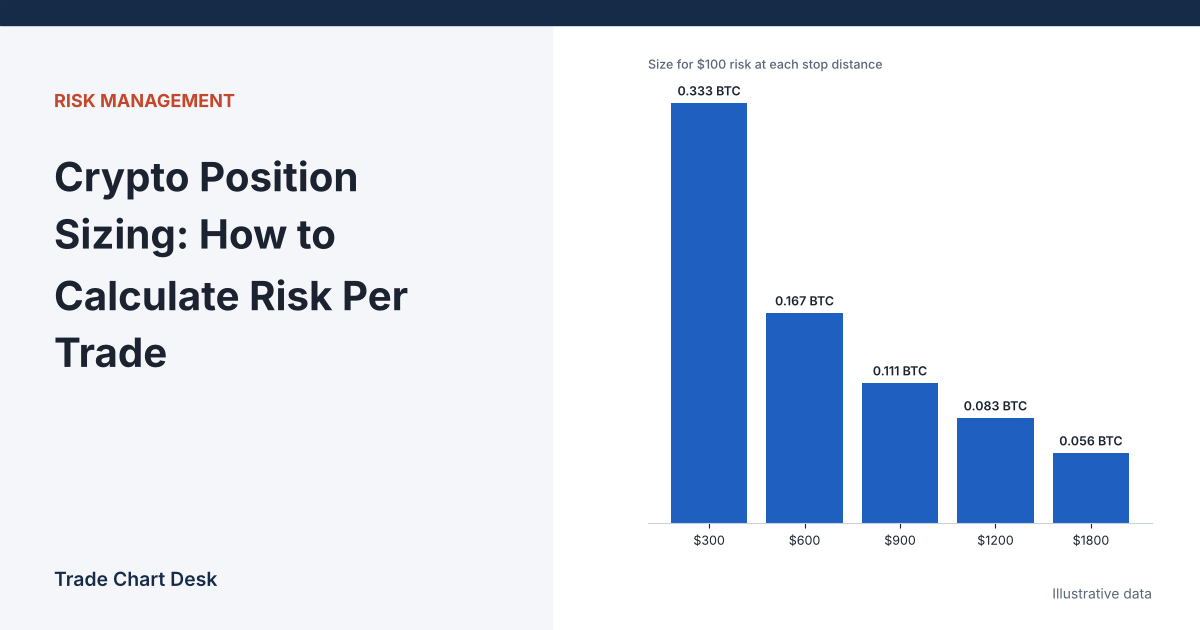
A common belief among new futures traders: “I only use 5x leverage, so my risk is low.” Leverage does not set your risk. Your stop distance and your position size do. Two traders using 5x and 50x can lose exactly the same dollar amount on a trade, and a trader using 2x can lose far more than either. This guide gives you one formula for position size, then adjusts it for the things that make crypto different: trading fees, leverage and margin, and contracts that are not denominated in coins.
The core formula
Position size (in coins) = Dollar risk ÷ Stop distance per coin
Where:
- Dollar risk = account equity × risk percentage. Many traders use 0.5% to 2% per trade. The point is not the specific number but that it is fixed before you look at the chart.
- Stop distance = |entry price − stop price|. The stop comes from the chart (where the trade idea is wrong), not from how much you want to make.
Notice the order. You choose the stop first, then the size falls out of the arithmetic. Traders who pick a size first and then squeeze the stop to fit are sizing backwards, and their stops end up inside normal noise. Our ATR guide covers one way to measure that noise.
Worked example: ETH long, step by step
All figures illustrative.
- Account equity: $5,000. Risk per trade: 1%, so dollar risk = $50.
- Entry: $3,000. Stop below the last swing low: $2,910. Stop distance = $90 (3%).
Position size before fees = 50 ÷ 90 = 0.5556 ETH. Notional value = 0.5556 × 3,000 ≈ $1,667.
Check: if the stop fills exactly at 2,910, the loss is 0.5556 × 90 = $50. Good. But the stop rarely fills for free.
Add the fees
You pay a fee to enter and another to exit, and both are charged on notional value, not on margin. Binance’s own futures fee explanation uses an example taker rate of 0.05% for regular users. Fee schedules change and vary by exchange and tier, so use your own rate. With a 0.05% taker fee on both sides (stop-market exits are taker orders):
Cost per coin if stopped = stop distance + entry × fee + stop × fee
= 90 + 3,000 × 0.0005 + 2,910 × 0.0005 = 90 + 1.50 + 1.455 = 92.955
Fee-adjusted size = 50 ÷ 92.955 = 0.5379 ETH (notional about $1,614). Losing at the stop now costs about $48.41 in price movement plus $1.59 in fees: exactly $50.
Fees cut the size by about 3% here. With a tight stop the effect is much larger: on a 0.5% stop, round-trip fees of 0.1% are a fifth of your risk. Slippage works the same way; if you usually see a few dollars of slippage on stop fills, add it to the cost per coin.
Where leverage fits (and where it does not)
Leverage decides how much margin the exchange locks up for a given notional position. It does not appear in the sizing formula at all.
| Leverage | Position (ETH) | Notional | Margin required | Loss if stopped |
|---|---|---|---|---|
| 1x (spot) | 0.5379 | ~$1,614 | ~$1,614 | $50 |
| 5x | 0.5379 | ~$1,614 | ~$323 | $50 |
| 20x | 0.5379 | ~$1,614 | ~$81 | $50 |
Same position, same risk, different margin. So why not always use the highest leverage? Because the liquidation price moves closer to entry as margin shrinks. At 20x isolated margin, a move of a little under 5% against you can liquidate the position; that is only slightly beyond our 3% stop, and a fast wick or a gap past the stop can reach it. The practical rule:
Set leverage low enough that the liquidation price sits well beyond your stop, with room for slippage. If liquidation is at or inside your stop, the exchange will close your trade before your plan does. How much buffer you have depends on whether you use isolated or cross margin; see cross vs. isolated margin.
The reverse mistake is more dangerous. A trader who thinks in leverage (“I’ll put $500 in at 10x”) has a $5,000 position. With a 3% stop, that is $150 of risk, three times the plan, and nothing on the order screen says so.
Contract sizes: converting coins into what you actually type
Many venues do not let you enter “0.5379 ETH.” You enter contracts or lots, so add one step.
Linear contracts (USDT- or USD-margined, sized in coins)
Contracts = coin size ÷ coins per contract, then round down to the venue’s step size. Example: CME Micro Bitcoin futures are 0.1 BTC per contract, according to StoneX’s summary of CME bitcoin contract specs. With $250 of risk and a $1,500 stop distance, coin size = 250 ÷ 1,500 = 0.1667 BTC, which is 1.67 contracts. You can trade 1 contract (risk $150) or 2 (risk $300). Rounding down keeps you inside your limit; rounding up breaks it. When the minimum size is larger than your risk allows, the honest answer is to skip the trade or trade a smaller product.
Inverse contracts (coin-margined, sized in USD)
On inverse contracts each contract is a fixed dollar amount and profit and loss is paid in the coin. Binance’s BTCUSD coin-margined contract, for instance, is commonly specified at $100 per contract (check your venue’s contract spec). The loss per contract between entry E and stop S on a long is:
Loss in BTC per contract = contract value × (1/S − 1/E)
Example: entry 100,000, stop 98,000, contract value $100. Loss per contract = 100 × (1/98,000 − 1/100,000) ≈ 0.00002041 BTC. If you risk 0.005 BTC, you can trade 0.005 ÷ 0.00002041 ≈ 245 contracts. The non-linear payoff means the same price move in dollars produces slightly different coin losses depending on where price is, so recalculate each trade rather than reusing last week’s contract count.
Common sizing mistakes
- Using margin as “risk.” The money posted as margin is not your planned loss. Only the stop and size define that.
- Sizing off starting equity after losses. After a drawdown from $5,000 to $4,000, 1% is $40, not $50. Recompute from current equity.
- Ignoring correlated positions. Long BTC, ETH and SOL at 1% each is close to one 3% bet, because they often move together.
- Forgetting funding. On perpetual futures held for days, funding payments add to or subtract from your result. Include an estimate of funding in your cost per coin if you expect to hold through several funding intervals.
- Moving the stop after sizing. If you widen the stop from $90 to $150 without reducing size, your 1% risk silently becomes 1.67%.
Build a calculator you trust
Put this in a spreadsheet with one row per trade: equity, risk %, entry, stop, fee rate, slippage allowance, coins per contract, and step size. Formulas: dollar risk; cost per coin; raw size; contracts rounded down; actual dollar risk after rounding. Then, after each closed trade, compare actual loss or gain with the planned R. If your real losses at the stop are regularly 1.2R instead of 1R, your fee or slippage inputs are too optimistic. Logging this in a trading journal turns that check into a habit. To decide whether a trade is worth taking once it is sized, our risk-to-reward and win rate guide picks up where this one ends.
Financial disclaimer: This article is for educational purposes only and is not financial, investment, or trading advice. Trading involves substantial risk of loss. Example figures are illustrative.
9 thoughts on “Crypto Position Sizing: How to Calculate Risk Per Trade”