
A coin you have been watching breaks out of a range at $2.00 while you are away from the screen. When you check, it is at $2.24 and the chat you follow is full of rocket emojis. The question in your head is “should I get in before it goes higher?” A better question is “what does this trade look like now, at this price, with the stop where it has to be?” Fear of missing out is not cured by willpower. It is reduced by having to answer that second question, in writing, before any order goes in. This article gives you the calculation, the rules and the checklist to do that.
What chasing actually does to the trade
Take the setup above with illustrative numbers. The plan, made before the breakout, was:
- Entry on the breakout: $2.00
- Stop below the range: $1.90 (risk $0.10 per coin)
- Target at the next resistance: $2.40 (reward $0.40 per coin)
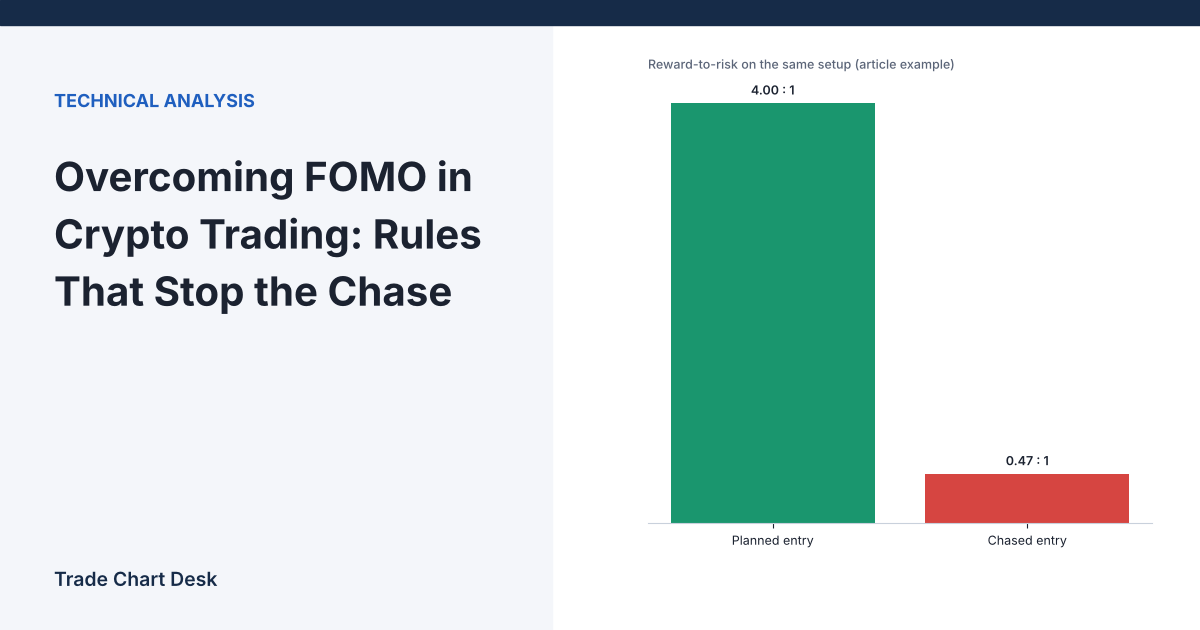
Now compare the planned entry with the chase entry. The stop and target do not move, because the chart did not change; only your entry did.
| Planned entry ($2.00) | Chase entry ($2.24) | |
|---|---|---|
| Risk per coin | $0.10 | $0.34 |
| Reward per coin | $0.40 | $0.16 |
| Reward-to-risk | 4.0 : 1 | 0.47 : 1 |
| Win rate needed to break even | 20% | 68% |
| Position size for $100 risk | 1,000 coins | 294 coins |
The break-even win rate is 1 ÷ (1 + reward-to-risk). The same idea went from needing to be right one time in five to needing to be right more than two times in three. Our risk-to-reward guide explains the formula.
The last row is where FOMO usually does real damage. Traders who chase rarely cut their size to 294 coins. They buy the 1,000 they planned, which at a $0.34 stop is $340 of risk, more than three times the plan. Or they keep the size and move the stop up to $2.14 to “keep risk the same,” which puts it inside normal pullback range. Either way, the trade they are now in is not the one they analyzed.
Five pre-trade rules that remove the decision from the moment
These work because they are decided while you are calm and enforced when you are not.
- Maximum entry distance. Write a number: “I will not enter more than X above my planned entry.” A practical way to set it is in terms of your stop: for example, no entry if the price has moved more than 30% of the stop distance past the trigger. In the example, that is $2.00 + 0.3 × $0.10 = $2.03.
- Minimum reward-to-risk at the actual entry. Recalculate with the live price, not the price you wished you had. If it falls below your minimum (say 2 : 1), there is no trade.
- Size from the stop, every time. Position size = dollar risk ÷ (entry − stop). If the stop is further away, the position is smaller. Our position sizing guide walks through it.
- A missed trade has a defined second chance, or none. Decide in advance what a valid re-entry looks like, typically a pullback to the breakout level that holds. If price never offers it, the trade is gone. See our guide to breakout and retest entries for how traders define that pullback.
- A daily cap. A maximum number of new trades per day, and a stop-trading rule after a set loss (for example, two full losses). FOMO often shows up right after a loss as the urge to “make it back.”
The 60-second checklist before any unplanned entry
Keep this next to your screen or pinned in your trading notes. Every “no” is a no trade.
- Was this setup on my watchlist before it moved? (Yes / No)
- Is the current price within my maximum entry distance? (Yes / No)
- Where is the stop that the chart, not my budget, says is correct? (Write the price)
- Reward-to-risk at the current price is at least my minimum? (Yes / No)
- Position size calculated from that stop, not from habit? (Write the size)
- Have I hit my daily trade or loss limit? (Yes / No)
- Is the reason for entry on the chart, or in a chat, a post, or a price alert? (Write the reason in one line)
The written fields matter. Typing a stop price and a size forces the arithmetic, and the arithmetic is usually what kills a bad chase.
Where FOMO comes from in crypto specifically
- Markets never close. There is no closing bell to end the session, so every hour you are away feels like an hour you might miss something. Pick the hours you trade and close the app outside them.
- Social feeds compress time. You see the coins that already moved, never the hundred that did not. The U.S. SEC’s investor alert on social media and investment fraud warns that fraudsters exploit investors’ fear of missing out, that online activity can create a false impression of consensus, and that you should not be pressured to act quickly. Urgency is a feature of manipulation, not a feature of good setups.
- Leverage is one click away. When a missed move feels expensive, leverage looks like a way to catch up. It also brings liquidation closer; see our cross vs isolated margin guide before you combine the two.
- Alerts are not signals. A price alert tells you something moved. It does not tell you the trade is still valid at the new price.
When the rules fail
Rules have costs, and you should know them so you do not abandon them the first time they bite.
- You will miss real moves. Some breakouts never pull back. A maximum entry distance guarantees you will sit out some of the biggest runs. That is the price of not overpaying on the many that reverse. Judge the rule over 30 or more instances, not on the one that got away.
- Rules can be bent quietly. “This one is different” is the most common way a checklist dies. If you override a rule, log it as an override, so you can see later whether overrides helped or hurt.
- FOMO can flip into fear. After a bad chase, some traders stop taking valid setups at all. If your log shows planned trades you skipped, that is the same problem pointing the other way.
- Rules do not fix a bad plan. If the setups on your watchlist have no edge, refusing to chase only makes you lose more slowly.
Test whether FOMO is costing you
You can measure this from your own history in an hour.
- Go through your last 30 to 50 trades in your trading journal or exchange history.
- Tag each trade as planned (on the watchlist with entry, stop and target defined beforehand) or unplanned (entered after the move, from an alert, a post, or impulse).
- For each group, compute the number of trades, win rate, average result in R, and total P&L.
- For unplanned trades, also record how far price was from the original trigger at entry and whether size matched your normal risk.
If the unplanned group has a lower average R or larger average losses, you now have a specific number for what FOMO costs you, which is far more persuasive than any reminder to “stay disciplined.” Going forward, add an “entry type” field to every trade so the comparison updates itself.
Financial disclaimer: This article is for educational purposes only and is not financial, investment, or trading advice. Trading involves substantial risk of loss. Example figures are illustrative.
1 thought on “Overcoming FOMO in Crypto Trading: Rules That Stop the Chase”